

Process and construction
Time is the real raw material of contemporary construction
Materials, technologies and performance matter, but in many real estate projects the decisive factor is something else: time, which design has to learn to govern.
by Massimo Rodighiero4-minute read
When people talk about construction, they tend to talk above all about materials, technologies and performance.
Timber or concrete. Prefabrication or traditional construction. Energy efficiency, building services, construction systems.
These are important issues, and they will only become more so. Yet looking at many of the real estate projects of recent years, it is clear that the decisive factor is often something else: time.
For a long time the construction industry treated time as an almost inevitable variable, something to manage and contain, but rarely a central element of design. Today the limits of that approach are plain to see.
Time has become an increasingly precious economic resource. It is for businesses that need to expand their plants to sustain growth. It is for those building hospitality facilities, which only start to generate revenue once they open. It is for investors who tie up capital for years before a project is complete. It is for public authorities that must respond to ever more urgent housing needs.
In all these cases, a project is measured not only by the quality of the end result, but by its ability to deliver it at the right moment.
A building completed a year late is not simply a building handed over later. It is an investment that has lost a year of opportunity, revenue, use and, often, competitiveness.
That is why time should enter the decision-making process much earlier, when the strategy of the project itself is being defined.
Designing the process before the building
Many of the innovations transforming the industry do not come from a wish to use different materials, but from the need to govern time better.
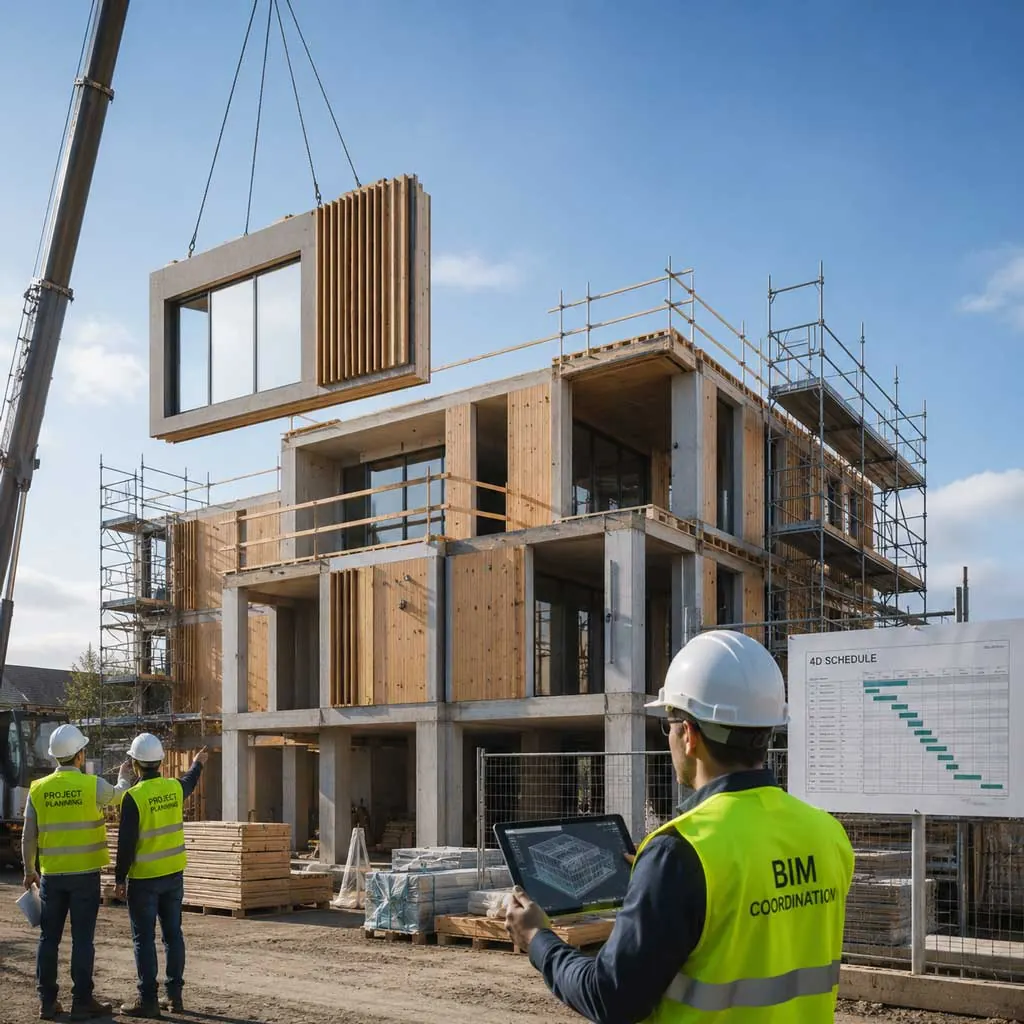
Digital processes, BIM (opens in a new tab), integrated design, prefabrication, the industrialisation of certain trades and growing coordination between disciplines all respond, in different ways, to the same need: reducing uncertainty and increasing predictability.
The real question, then, is not only how a building will be constructed, but how the process that leads to its construction is designed.
For decades, construction accepted a very high degree of improvisation. Variations, clashes, delays, overlaps and coordination problems were treated as almost normal. Today that approach is becoming less and less sustainable.
Margins are shrinking, capital is more expensive, regulatory complexity is growing and competitiveness demands ever faster response times.
A growing share of decisions therefore has to move from the final stages on site to the early stages of design.
In other words: design more, to build better.
When time creates value
It is within this shift that tools such as prefabrication and industrialised construction systems find their place.
Not because they are a universal solution or the right answer for every project, but because they allow the relationship between design, construction and time to be approached differently.
Used well, these tools make it possible to bring decisions forward, reduce work on site, increase quality control and compress the overall programme.
Paradoxically, they make design even more important.
The quality of a building still depends on the quality of the choices behind it. The difference is that today those choices have to be made much earlier, and with greater awareness.
A challenge for the whole industry
This change does not affect only logistics or heavy industry.
It concerns a growing part of the construction sector.
Whether in housing, hospitality, production spaces, public buildings or community facilities, it is increasingly clear that the value of a project depends on the ability to coordinate people, skills, technologies and processes within a shared vision.
The building is still the end result.
The project’s competitiveness, however, is built much earlier, at the stage when the decisions are made that will determine its time, cost, quality and capacity to create value.
That is why time is becoming the real raw material of contemporary construction, and design has to learn to govern it.
In short
What this means for those who invest and build
Treating time as a design resource means assessing every project not only on its construction cost, but on its capacity to create value when it is needed.
The choice of technologies, the organisation of the process, the coordination of expertise and the management of permits thus become an integral part of the investment’s financial viability.
In this context, building faster means designing with greater awareness, reducing uncertainty and making more efficient use of one of the most precious resources in any project: time.
